
Why Ghost Kitchens Failed (And What’s Coming Next)

Why Ghost Kitchens Failed (And What’s Coming Next)
The Most Expensive Lesson in Restaurant History
In 2021, investors poured over three billion dollars into ghost kitchens. Venture capital firms fought over equity stakes. Celebrity Chefs launched virtual brands. Travis Kalanick, Uber’s co-founder, raised $850,000,000 to build CloudKitchens at a $15 billion valuation backed by Microsoft. Kitchen United raised $100,000,000 in July 2022, then shut down all eight Kroger locations by November 2023, eliminating 44% of its entire 18-unit footprint.
By early 2023, CloudKitchens facilities ran at 50% occupancy. Forty-one of seventy-one restaurants at five CloudKitchens locations closed within one year. A 58% failure rate.
The ghost kitchen was supposed to be inevitable. Industry projections promised it would account for over 20% of restaurant sector revenue by 2025. Wendy’s promised 700 ghost kitchen locations through a partnership with Reef. Applebee’s launched virtual wings brands. Wonder, one of the sector’s largest players, raised $150,000,000.
None of it stuck. Today, most of these companies are gone or pivoting away from physical locations entirely.
This wasn’t a gradual decline. This was a collapse. And the operational lessons from that collapse matter for every restaurant operator right now, especially those tempted by hybrid models or delivery-only expansion.
The Illusion That Looked Like Math
A ghost kitchen eliminates everything restaurateurs spend money on. No dining room. No host stand. No servers. No bussers. No bartenders. No prime real estate with foot traffic. No expensive kitchen buildout for a polished dining experience. Just a commercial kitchen space in an industrial area, prep tables, and delivery boxes.
Lower cost structure equals higher profit margin was the irresistible pitch. Multiple revenue streams from one location. Test new concepts without opening new restaurants. Expand without traditional real estate risk.
The math works on a spreadsheet. In reality, it fails in every operational dimension that matters.
A typical restaurant runs at a 3% to 5% profit margin. Delivery platforms charge restaurants up to 30% commission fees. That commission eliminates the entire profit margin before the restaurant covers rent, equipment, labor, or marketing.
Layer on ghost kitchen operator rent. Add percentage fees on sales. Add equipment repairs. Add maintenance. Add marketing costs for invisible brands with no storefront. Add staff turnover in positions with zero guest connection and zero ownership.
The restaurant that once made twenty cents on every dollar now lost money on every order.
Nobody talks about this truth until the cash runs out.
Quality Control Became Impossible
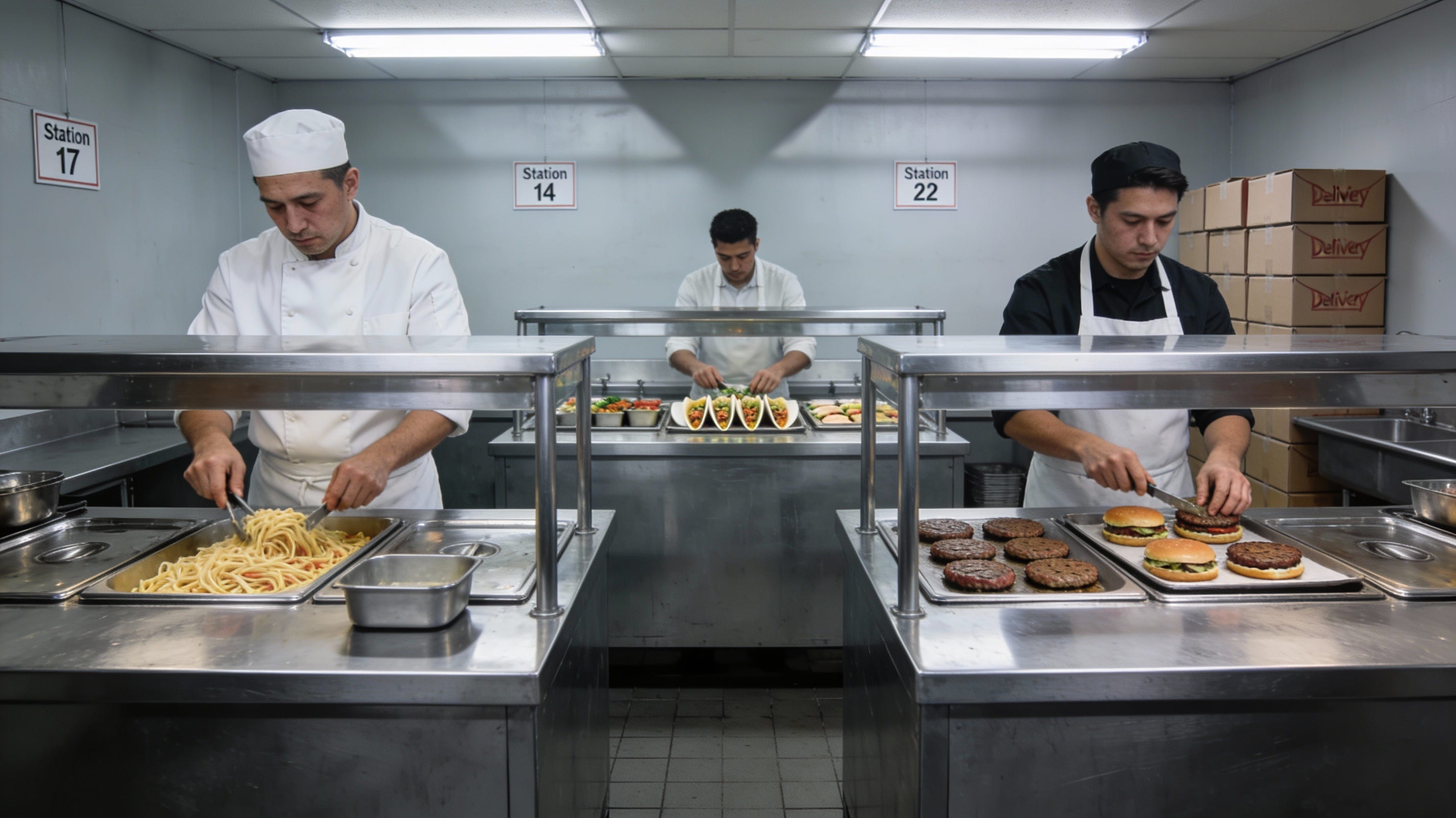
A shared kitchen space in a ghost kitchen facility handled dozens of virtual brands. A single cook prepared food for Italian pasta, then burgers, then tacos, all for different virtual restaurant brands operating out of the same location. Same workspace. Same equipment. Same hands. Different logos on the delivery apps.
This is assembly line production, not cooking. The cook has no connection to the brand. No relationship with customers. No accountability when food arrives cold or wrong. The brand itself is a stranger to the diner.
When food quality slips in a traditional restaurant, the server notices immediately. The manager can respond. Regular guests forgive occasional mistakes because they have built loyalty over time. The restaurant’s reputation is local and direct.
In a ghost kitchen, there are no regulars. There is no relationship. There is only an angry review on a delivery app posted by someone who ordered from a brand name they’ll never visit again. That review destroys a virtual brand instantly because there is nothing beneath it. No community. No reputation beyond the app. No second chance.
By 2023, Uber Eats removed approximately 8,000 virtual restaurant listings from its platform due to poor quality, inaccurate orders, and duplicate listings. Entire cohorts of delivery-only brands disappeared from the platform without a trace because they had no identity beyond an app listing.
Celebrity-backed virtual concepts like Hotbox by Wiz Khalifa and George Lopez Tacos generated terrible reviews and disappeared within months. The investment, the celebrity backing, the brand awareness meant nothing. Quality control in a shared kitchen is structurally impossible. Delivery times are unpredictable. Packaging breaks food. And the customer has no reason to ever try again.
The Human Problem Nobody Could Solve
Ghost kitchens promised to reduce labor costs by eliminating front-of-house staff. No servers. No hosts. No bartenders. Just cooks and delivery coordination.
What actually happened was that kitchens became sweatshops without purpose.
A cook working in a ghost kitchen prepares meals for brands that don’t exist as places. The work has no craft. The output has no identity. The cook’s skill means nothing because the brand disappears after one bad review. Nextbite endured three rounds of layoffs within fourteen months before selling to a competitor. Staff turnover spiked. Training costs are multiplied across multiple virtual concepts operating from the same location.
Meanwhile, delivery drivers became the only human face of these brands. Drivers represented brands they had never seen built. Drivers fielded complaints about quality that they didn’t control. Drivers bore the face of failed operations without the authority to fix anything.
For existing restaurants that tried ghost kitchen concepts within their own kitchens, the problem was different but equally fatal. A busy dinner rush combined with incoming delivery orders created chaos. Kevin Hochman, CEO of Brinker International, admitted that running a virtual wing brand called “It’s Just Wings” out of Chili’s kitchens became a nightmare. The infrastructure, the menu focus, the pacing, the labor allocation and none of it aligned. Dine-in service suffered. Delivery orders stalled. The hybrid approach crashed against the reality that one kitchen can’t execute two different operational rhythms at the same time.
The Delivery Model Was Built on Lies
Here is the truth about delivery economics that most people still don’t understand.
Stanford research shows that approximately thirty to fifty cents of every dollar spent on delivery represents genuinely new sales. The rest is cannibalized from existing dine-in revenue. When restaurants pushed delivery hard, they weren’t growing the pie. They were stealing from their own tables.
A meal costing $11.30 in-restaurant costs $19.40 on a delivery app. Customers pay the premium, or they don’t order. The restaurant’s profit margin swings from 15% to negative 7.6%. That is structural insolvency.
Ghost kitchens were built on the assumption that delivery demand would remain at pandemic levels. During lockdowns, delivery spiked because restaurants were closed. Customers had no choice. That spike looked permanent. It wasn’t.
When dining rooms reopened, customers returned to restaurants. Delivery growth stopped. Demand that looked infinite proved to be temporary and price-sensitive. 70% of diners expressed a preference for ordering from a publicly accessible physical location. Customers care about place. About identity. About being able to see where their food comes from.
Ghost kitchens promised to eliminate the need for a place. The place, however, is what restaurants actually sell.
What Really Works Now
The ghost kitchen dream is dead. What replaces it is more interesting.
Operators winning right now are building hybrid models that respect both channels without trying to make each channel into the whole business. A restaurant with dine-in service that also executes delivery well. A small kitchen with high-quality execution that serves its neighborhood. A fast-casual concept that operates efficiently without pretense. A themed micro-restaurant that creates enough experience around food that customers want to be inside the space.
These models are the opposite of ghost kitchens. They build identity. They create a local connection. They eliminate the pressure to scale infinitely because the business model doesn’t depend on moving volume through an invisible brand at 50% occupancy.
Some Operators are building culinary collectives. Local Kitchens operates as a physical restaurant featuring multiple menus from respected Chefs, all prepared from one kitchen. This isn’t a delivery-only play. This is a place where customers can sit down, eat food from a Chef they trust, and experience what makes the concept distinct. The kitchen executes multiple menus, just like ghost kitchens promised. The presence of diners inside the space creates quality control, creates accountability, creates reason for excellence.
Others are building micro-restaurants. Smaller footprints. Tighter menus. Lower fixed costs. Sustainable margins. A focus on operational discipline rather than growth at any cost. When every square foot has to earn revenue, restaurants get selective about what they build.
Still others are operating delivery-focused brands, but connected to recognized restaurants. Nextbite and Meal Outpost are platforms that license established restaurant brands into kitchens where they work. The food is from a brand customers recognize. The quality is backed by the host restaurant’s reputation. The delivery order is connected to something real, not floating in digital space with no anchor.
The common thread is that successful restaurants are choosing to be places first. Delivery is a channel, not an identity. The business works because it builds something local and defensible, not because it promises to scale infinitely with venture capital.
The Lesson for Your Operation Right Now
If you’re running a traditional restaurant and someone pitches you on a ghost kitchen expansion, here is what matters.
Your profit margin is 3% to 5%. The restaurant next to you makes the same margin. The ghost kitchen promise is that you make money on delivery by eliminating the cost of a dining room. The platform commission is 30%. The math doesn’t change because you removed four walls.
If you want to expand into delivery, do it from your existing kitchen during off-hours. Train delivery to operate with dine-in service, not against it. Protect your core business first. Add revenue channels where they fit operationally, not where investors say they should fit.
If you’re a Chef or Operator thinking about opening a new restaurant, the ghost kitchen pitch is tempting. Lower investment. Faster launch. Multiple revenue streams. You’re selling food in a space that doesn’t exist as a place. You have no reputation. You have no community. You have no leverage with delivery platforms.
Build something real first. It costs more. It takes longer. It survives. Real restaurants have survived recessions, market shifts, and changing consumer behavior because they built local loyalty that no algorithm can destroy.
Ghost kitchens failed because they tried to build restaurants without building community. Without community, all you have is a delivery order to a brand name that disappears after one bad review.
Choose the harder path. Build a place.
#RestaurantEconomics #GhostKitchens #RestaurantFail #FoodIndustry #RestaurantBusiness #DeliveryEconomics #OperationalReality #Hospitality #RestaurantTrends #FoodService #2026Trends #RestaurantLeadership
Follow along for free to get the unfiltered analysis on what actually works in this industry. No venture capital legends. No consultant jargon. Just operational reality from someone who has watched these decisions crush businesses and watched others survive because they built something real.
Really strong breakdown of why the ghost kitchen model crumbled. The "sweatshops without purpose" observation is sharp, since removing customer-facing interactions killed any craft motivation for kitchen staff. Watched something similar happen wit a local restaurant that tried virtual brands durng 2022, cook turnover doubled within 3 months because there was zero pride in the work. Makes sense that successful hybrid models kept the physical place as primary, treating delivery as addition not replacement.