
I’m The Problem In The Restaurant

I’m The Problem In The Restaurant.
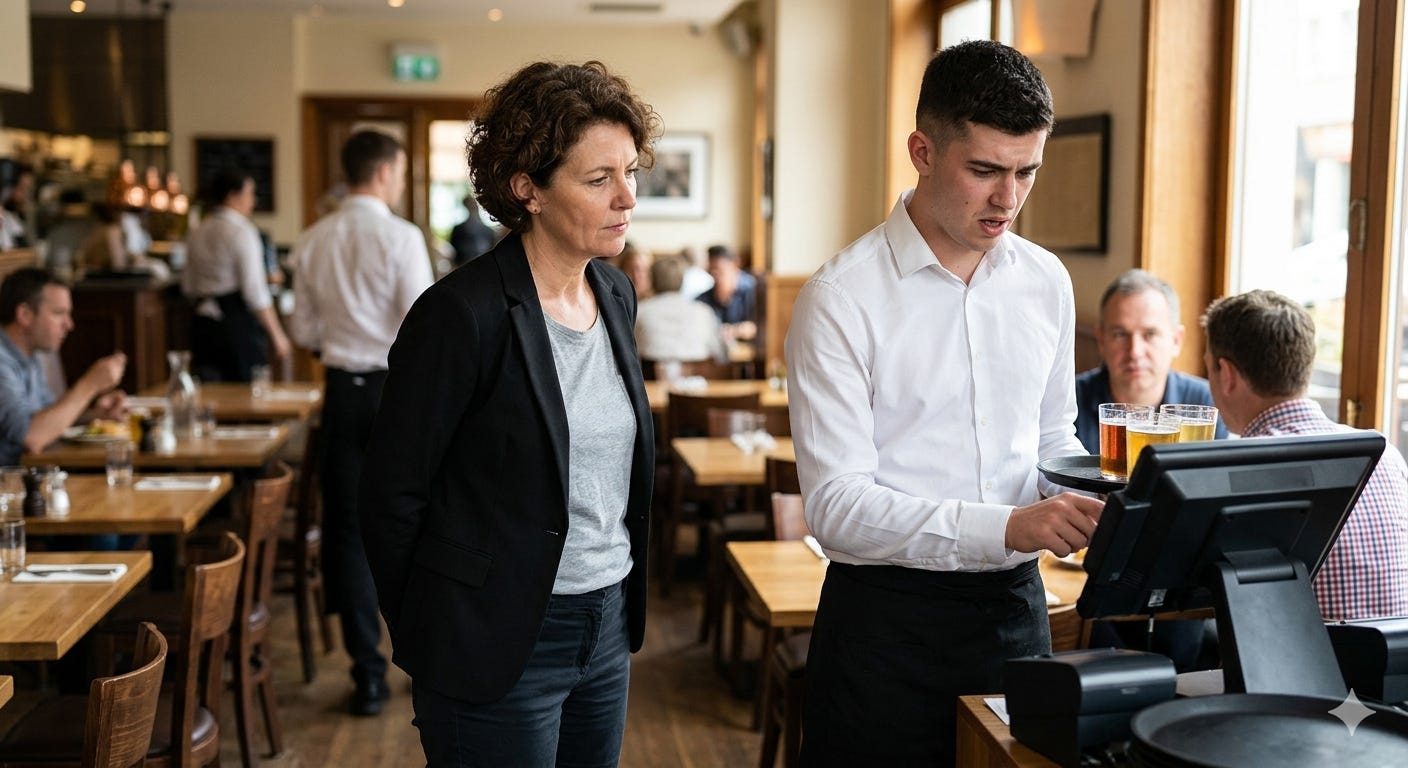
I watch a manager stare at a problem for 30-seconds, this seems like a lifetime to me, and I jump in before they have a chance to figure it out.
For a long time, I thought I was good at training managers. Turns out I was fast at it. It’s not the same thing. Fast is when a new manager would get lost trying to fix something, friction starts to build, and before it became a lesson learned, I’d filled the gap. I cover the floor. I run the pre-shift. I handle the 86s. They’d watch me do it and think they learned something. They didn’t. They learned that if they hesitated long enough, I’d handle it.
I trained them to wait for me.
When I was a manager trying to become a GM, I got praised for this. Quick action. Strong floor presence. Nothing falling through the cracks. It was part of why I got promoted. The feedback I was getting built the habit. Nobody told me I was training dependency. They told me I was running a tight ship.
In time, I grew to understand that my behavior was the problem. I just didn’t know how to stop. I’ve worked with other people who understood that their behavior could also be a problem for their restaurant. People who went their whole careers without seeing it. I don’t say that to feel better about myself. I say it because knowing you’re the problem and knowing what to do about it are two different things, and for a long time, I only had the first one.
The weight of that lands differently when you’re the GM. When I was coming up, stepping in meant I was sharp. Now it means the people I’m responsible for developing aren’t developing, and that’s on me alone. Nobody above me is absorbing that cost anymore.
I had a new manager learning the opening reports. I told them how. I showed them how. I did it once while they watched, then stood next to them while they did it themselves.
Then they were on their own. I was off or closing, the training overlap was gone, and the reports weren’t getting done right.
My first read was that they hadn’t taken good enough notes. That it wasn’t complicated and they should have it by now. What I didn’t do was stop and ask what was actually breaking down.
They needed more verbal walkthroughs with me present. More reps with someone alongside them asking questions, not just watching. They needed a written reference, not one I assumed they’d build on their own, but one I should have coached them to make or made with them.
I’m neuroatypical. Without unpacking the whole thing, I didn’t understand it then. When I learn something, I build the internal structure for it and run on that. I assumed they’d do the same thing. I assumed they’d know they needed a reference sheet because I would have known I needed one. That’s not how it works. They weren’t me. They processed the training differently, needed different supports to make it stick, and I had no real read on that because mapping how someone else experiences something doesn’t come naturally to me.
I was teaching to myself and calling it training.
They eventually got it. Longer and harder than it needed to be, and the structure I built is why.
I knew better. Real learning happens in the failure, not the fix. You have to let someone miss the mark, feel the consequence, and figure out what went wrong. I know that. I can’t hold the discomfort of watching it happen, so I told myself I was helping and stepped in every time.
Every time I did, I subtracted from that person’s ability to trust themselves on the next thing.
When I’m stressed, I slow my rate of speech down. I choose my words very carefully. I do it to keep from saying something I can’t take back. I thought I was projecting control. I was projecting that I thought the person in front of me needed to be handled carefully.
I’d be walking through a scheduling accountability issue, and the manager I was coaching would be deciding whether she still wanted the job. I could feel something shift, and kept thinking she wasn’t following the material.
She was following it fine. She was furious.
A different manager told me in the parking lot after a close that she felt like she was being spoken to like a child. She didn’t say it to wound me. She said it because she’d been waiting for the right moment, and that was it. I’d been doing it for years. She was the first person to say it out loud.
What I do now is pause before I start talking, not while I’m talking. I run through a couple of ways the conversation could go, pick the one most likely to land, and then try to say it the way I say everything else without signaling that I’m doing any of that. It still slips. I catch it faster now.
When they’re struggling and nobody’s bleeding, I leave the room. The discomfort I’m feeling isn’t their problem to absorb.
For training, I build the handoff for the conditions they’ll actually work in. More reps. More verbal prompts. A reference built together before the schedule splits, and I’m gone. Training without that bridge isn’t training. It’s a demonstration.
I struggle with these things. Always have, probably always will. Some days I’m better with them than others, and I know when I’ve lost ground. I try hard not to go back to older ways of doing things. Being a less obstructive version of myself than I was the week before. Some weeks that’s the whole win.
I don’t know if the instinct to jump in ever fully goes. You’ve seen how the situation ends, and you want to shortcut the person past the damage. But that’s still about you. The person in front of you needs the rep, not the rescue.
#RestaurantManagement #HospitalityLeadership #FoodServiceLeadership #RestaurantOperations #Restaurant101
I write about what actually happens in restaurants including the management failures, the training gaps, and the things nobody says out loud until someone finally does. Follow along for free.
A regular look in the mirror is essential
I was CEO of a small 🇨🇦 accounting software company whose staff fluctuated between 6 and 40 during the 35 or so years I was in charge. We sold through a network of small independent dealers who were more business process consultants than IT people. So, nothing to do with restaurants.
But I have now sent links to your substack to 6 people in leadership roles I stay in contact. Your advice is 🎯 and clearly written.
This column has become one of my favourite (favorite) reads.
Many thanks.