
Why Restaurant Portion Sizes Are Destroying America’s Health And Your Profit Margins

Why Restaurant Portion Sizes Are Destroying America’s Health And Your Profit Margins
A customer sits down in a restaurant and orders an entrée. The plate arrives heaped with food. By the time they finish halfway through, they have consumed their entire day’s recommended calorie intake in a single meal. Meanwhile, your kitchen hemorrhages money through oversized portions, and 30-40% of uneaten food becomes waste with no profit return. The portion size crisis isn’t simply a public health failure. It is a calculated business model that has become a threat to both American health and restaurant profitability. Portion inflation started as a competitive advantage in the 1970s when food became cheap and abundant. It has evolved into a business straightjacket trapping independent restaurants between customer expectations and wafer-thin margins.
The Portion Inflation Crisis
The history of American portion inflation reveals a calculated industry strategy that backfired. In the 1970s, agricultural policy and Green Revolution innovations made food remarkably inexpensive. Restaurants discovered they could offer substantially larger portions with only marginal cost increases.¹ By charging the same price for extra pasta or a larger bread basket, chains marketed perceived value without eroding margins. Customers equated size with value. McDonald’s introduced supersizing. Fast food chains launched combo deals. Restaurants bulked up plates with low-cost carbohydrates: pasta, rice, potatoes. The logic was simple. Cost an extra 50 cents to serve, charge an extra $5, profit soared.
Portion sizes began growing in the 1970s and rose sharply in the 1980s.¹ Between 1970 and today, Americans consume 23% more calories daily.³ Spaghetti portions doubled to one pound. Bagels expanded from 2 ounces to 4 ounces. Cheeseburgers grew from 5.9 ounces to 7.3 ounces. Fast-food items became 2 to 5 times their original sizes.¹,³ The USDA and FDA established serving size standards in the 1970s and 1980s based on consumption data from that era. Those standards were never meaningfully revised, even as portions expanded far beyond government health guidelines.
What started as a marketing tactic transformed American baseline expectations for food. Customers stopped comparing portions to USDA guidelines. They compared portions to what other restaurants offered. Large portion sizes became the norm. A plate that seemed enormous in 1980 was standard by 2000. By 2020, it was meager. Restaurants attempting smaller portions were undercut by competitors offering supersized meals. The industry ratcheted up portion sizes in a race to the bottom, and nobody could afford to stop.
The Health Cost: 41.9% Of Americans Are Now Obese
The correlation between portion inflation and the obesity epidemic is not coincidental. It is real. The Centers for Disease Control reports that obesity among U.S. adults reached 41.9% during 2017 to March 2020, up from 30.5% in 1999-2000.² Severe obesity, defined as a BMI of 40 or higher, affected 9.2% of adults.² This is an unprecedented public health disaster, and portion sizes are a primary culprit.
The research is brutal. When portion sizes increase 50%, people consume 10-40% more calories from that meal, regardless of hunger cues or willpower. When portions double, consumption increases by 30-55%.⁴ The effect is consistent across demographic groups, age ranges, body weight categories, and income levels. This is not a willpower problem. This is marketing psychology. Your body processes visual and contextual cues about available food and tells your brain to eat more.⁴
The consequence is a $412.9 billion economic burden from diabetes alone, including $306.6 billion in direct medical costs and $106.3 billion in lost productivity.⁷ Obesity and overweight conditions cost the healthcare system at least $173 billion annually.⁶ Type 2 diabetes, the leading preventable chronic disease in America, is fundamentally linked to portion-driven obesity. Research tracking restaurant food consumption found that eating fried chicken at least twice weekly increased type 2 diabetes risk 68% compared to never eating such meals.⁵ Portion size got us here.
Why Size Became a Trap
Restaurants operate on wafer-thin margins that make oversized portions economically indefensible. Full-service restaurants average net profit margins between 2% and 5%. The cost structure is brutal with food consuming 30-35% of revenue, labor another 30%, overhead (rent, utilities, insurance, maintenance) 25-30%. This leaves virtually nothing for profit. Any deviation in food or labor costs erodes the bottom line immediately.
When you operate on a 3% to 5% margin, every dollar of wasted food comes directly from profit. Larger portions accelerate waste at multiple points. First, diners cannot finish their plates. Restaurants generate half a pound of food waste per meal served, whether from customer plate waste or kitchen mistakes. Approximately 17% of each diner’s meal ends up in the dumpster.⁸ Second, the kitchen must prepare ingredients for larger portions, and overproduction is inevitable. Restaurants waste 4-10% of purchased food, and 30-40% of food served is never eaten.⁸ American restaurants waste approximately 5.76 million tons of food annually, costing the industry $162 billion per year.⁸
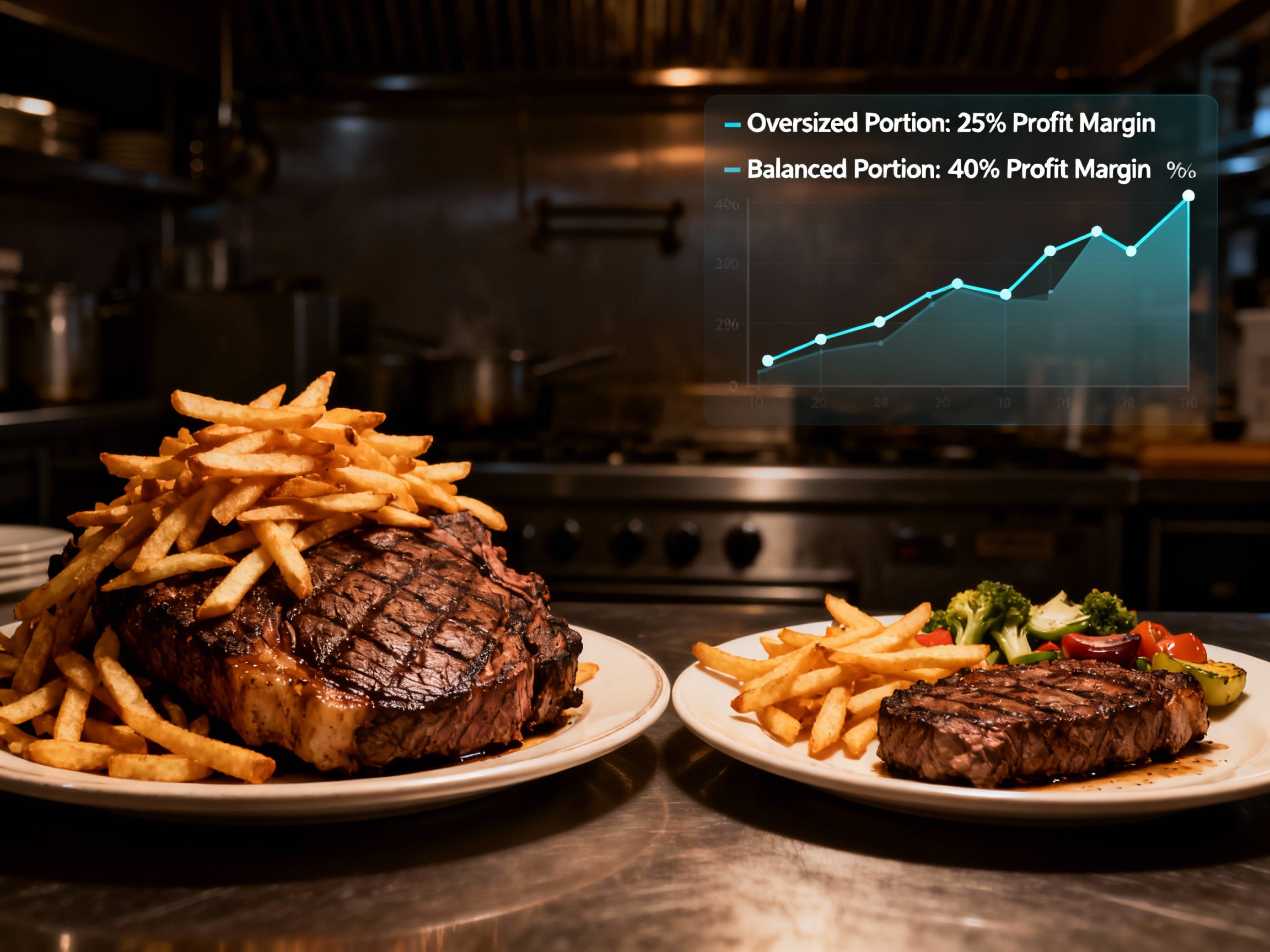
The math is brutal. For a restaurant with $2 million in annual revenue and 33% food costs, a 5% reduction in portion sizes generates approximately $33,000 in recovered annual profit, moving a 3% margin closer to 5%. For a restaurant with five locations and $10 million combined revenue, the recovery exceeds $165,000 annually. This is not a marginal improvement. This is survival.
74% Want Smaller Portions
A seismic shift in consumer behavior is now reshaping restaurant strategy. 74% of customers want smaller portions.¹² 44% of American adults now order from kids’ menus to save money and eat less.¹² A Georgetown University study found that 50% of consumers prefer smaller serving sizes.¹¹ This is not a fringe demand. This is mainstream customer preference being ignored by an industry too committed to its old playbook.
Why this shift? Multiple drivers converge. First, consumers increasingly snack throughout the day, arriving at restaurants with smaller appetites. Second, meal-sharing and solo dining have replaced family-style portions. A person eating alone cannot reasonably finish a dish designed for four. Third, GLP-1 weight loss medications like Ozempic and Wegovy have entered mainstream use. These are not price shoppers or health zealots. These are mainstream customers actively seeking portion-appropriate meals.
Forward-thinking restaurants have already moved on this. Olive Garden, owned by Darden Restaurants, began testing Lighter Portion Entrées at 40% of locations in early 2025, offering seven signature dishes in smaller portions priced between $12.99 and $13.99, while retaining unlimited breadsticks and soup or salad. Results shocked observers. Affordability scores increased 15%. Same-store sales grew 5.9%, exceeding expectations.¹³ Customer frequency increased without marketing. Diners were existing patrons choosing smaller portions more frequently. The test proved customers don’t need persuasion into smaller portions. They actively want them when available.
P.F. Chang’s redesigned its entire menu to offer two portion sizes and launched individual-portion dinners with appetizers and sides bundled at fixed prices.¹⁴ These are not boutique restaurants experimenting with niche concepts. These are large casual-dining chains responding to customer data and market signals. The shift is real and accelerating.
Portion Control Destroys Bad Assumptions And Helps Your Margins
The traditional restaurant argument against portion reduction rests on assumptions research has debunked. Restaurant owners believed customers equated large portions with value. Smaller portions, they feared, would trigger perceptions of being cheated and forced price reductions that would kill margins. This logic has failed every stress test.
When smaller portions are framed properly on the menu, customers accept them at prices that improve margins. A study testing portion-size descriptors found that naming a smaller portion “Standard” or “Just Right” rather than “Small” meaningfully increased the likelihood customers chose it, even when the price was 70% of the larger portion, meaning per-ounce cost was higher.¹⁵ Customers paid more per ounce for smaller portions while restaurants captured additional margin serving less food.
The operational barriers restaurant owners cite collapse under scrutiny. Fine dining restaurants have operated on smaller, artfully plated portions for decades without destroying business. The presentation challenge is real but solvable. Use smaller plates and bowls. Enhance visual appeal through height and color. Add more vegetables and garnishes. Use menu language that sells the concept. These are execution details, not constraints.
The economic argument is straightforward. A 10% reduction in portion sizes for a full-service restaurant with $2 million in annual revenue and 33% food costs yields approximately 6% to7% in reduced food costs.¹⁶ For a $2 million revenue restaurant, this translates to $13,200 to $15,400 in recovered annual profit, moving a 3% margin closer to 4% to 5%.
Three Actionable Strategies To Right-Size Profitably
Implementing smaller portions requires more than cutting portion sizes. It requires psychology, presentation, and communication. The following three strategies have been validated by operator experience and research evidence.
Strategy One: Menu Positioning And Language Matter More Than Price
Do not call it a small portion. Call it “Standard” or “Just Right.” Research confirms this isn’t marketing sleight of hand. It is cognitive accuracy. USDA and FDA serving sizes are actually the standard. It’s the restaurant’s portions that are abnormal. By naming the appropriate portion “Standard,” you tell the truth while nudging customers toward choices that happen to be more profitable.¹⁵ Place these options prominently on the menu, not hidden in a separate section. Describe them with sensory language like “hand-crafted,” “artisanal,” “balanced,” “locally sourced portions.” Fine dining menus have sold smaller portions for $30-50 per plate for decades by leveraging presentation and language. The principal scales.
Use the rule of three pricing. a value portion, a medium size, a premium size are the three you offer your guests. Customers overwhelmingly choose the middle option because it feels balanced. Many restaurants are already adopting this for the wines by the glass programs, with 4oz, 6oz, 8oz pours. If the middle option is your right-sized portion at appropriate pricing, you guide customers toward both profitability and health without coercion. The premium option preserves customer choice and accommodates different appetites.
Strategy Two: Bundle And Contextualize With Sides And Unlimited Offerings
Smaller portions paired with unlimited sides or bread baskets don’t compromise the profit of smaller entrées. Darden’s test at Olive Garden proves this. By pairing smaller entrées with unlimited breadsticks, soup, and salad, the restaurant maintained perceived value while reducing entrée portion costs. Customers see a full meal. The restaurant controls costs on the expensive protein portion while customers self-regulate on low-cost sides. Research shows that when people are served a low-energy-dense first course like salad or soup, they reduce intake of subsequent courses naturally.¹⁰ This is not deprivation. This is leveraging normal human psychology to create satisfaction with smaller portions of expensive ingredients.
Strategy Three: Staff Training And Portion Control Systems
Customers don’t resist smaller portions if the option is clearly presented. Beware of inconsistent execution. If one plate is 8 ounces and another is 10 ounces, customers’ notice and trust dies. Portion standardization requires investment in training and equipment. Purchase commercial portion scales, scoops calibrated to specific ounces, ladles marked by volume. Build portion checks into opening station procedures. Train staff to understand why portion control matters, not just how to execute it. Staff understanding that over portioning wastes food and destroys margins lets them become partners in cost control rather than resentful enforcers.
One restaurant operator reduced portion sizes 10-15% across the menu while training staff to emphasize that plates were designed to let customers enjoy ingredient quality without the heavy feeling afterwards. Positive customer feedback increased. Portion complaints decreased. The key was reframing the experience. Smaller portions were not cost reduction. They were respecting the customer’s desire to eat well without feeling stuffed.
Addressing Customer Pushback
Not all customer resistance to smaller portions stems from a desire for more food. Some reflect cognitive anchoring. Customers spent decades seeing enormous portions and internalized them as normal. The only remedy is gradual normalization and visible choice. When restaurants offer both standard and larger sizes side-by-side, customers eventually self-select into the option that matches their appetite. Research on portion normalization shows that exposure to smaller portions recalibrates customer expectations over time.¹⁰ After eating smaller portions regularly, customers report feeling satisfied with even smaller portions one week later, suggesting portion-size norms reset through repeated exposure.¹⁰
The emerging GLP-1 phenomenon was unexpected. Restaurants positioning smaller portions as health-conscious, nutrient-dense options rather than cost-cutting measures capture this demographic. High-protein options preventing muscle loss, portions fortified with fiber and micronutrients, artfully presented smaller dishes go hand in hand with GLP-1 use. They capitalize on it.
The customer who ordered a full entrée and consumed half now actively seeks an option serving their actual appetite. This is not resistance to overcome. This is a customer preference to fulfill. The profit opportunity is genuine.
The Profit Math Is Undeniable
The numbers force action. A 5% reduction in portion sizes for a full-service restaurant with $2 million in annual revenue and 33% food costs generates approximately $33,000 in recovered annual profit, moving a 3% margin between 4% and 5%. For a restaurant with five locations and $10 million combined revenue, recovery exceeds $165,000 annually. This is not a marginal improvement. This is survival. For restaurants already at the cliff edge of profitability, portion optimization is the difference between staying open and closing.
When Darden tested lighter portions without aggressive marketing, same-store sales grew 5.9% in one quarter.¹³ This wasn’t cannibalizing full-sized portion sales. This was attracting customers uncomfortable with the oversized portions. Revenue growth came from traffic generation. Customers who previously skipped restaurants, feeling obligated to overeat, now showed up more frequently. This is multiplicative value creation.
Good Health and Good Margins Are Not in Conflict
The American restaurant industry built its growth model on a calculation that has failed. Large portions at low cost created a competitive advantage. Customers equated size with value. Competition drove portion sizes higher until the physics of the human body and the economics of thin margins both snapped. The reckoning arrived simultaneously from two directions. First, 41.9% obesity rates are transforming restaurant meals into acknowledged health risks. Second, profit margins were so tight that over portioning became unsustainable rather than a marketing advantage.
Restaurant operators positioning for the next decade don’t fight this reckoning. They ride it. Smaller, portion-appropriate meals are not concession to health advocates. They are profit recovery mechanisms that happen to align with public health. They are customer preference matching market demand. They are margin enhancement allowing restaurants to survive inflation and labor cost escalation. They are response to emerging consumer segments actively seeking portion-appropriate nutrition.
The portion-size crisis that destroyed America’s health was created by restaurants. The solution exists in restaurants, too. The path forward requires abandoning the assumption that bigger is always better, embracing the data that smaller portions are what customers actually want, and accepting that rightsizing is not cost-cutting. It is right running the business.
#PortionCrisis #RestaurantMargins #HealthVsProfit #HospitalityTruth #ObesityEpidemic #RightSizing
Footnotes
Young, LR & Nestle, M. “The Contribution of Expanding Portion Sizes to the US Obesity Epidemic.” American Journal of Public Health, 2002.
CDC. “Adult Obesity Facts.” Centers for Disease Control and Prevention, 2025.
Dietary Guidelines Coalition. “Portion Balance Coalition Report.” McDonough School of Business, Georgetown University, 2024.
Rolls, BJ et al. “Portion Size and Obesity.” PMC National Center for Biotechnology Information, 2014.
Pan, A et al. “Consumption of restaurant foods and incidence of type 2 diabetes.” American Journal of Clinical Nutrition, 2009.
CDC. “Fast Facts: Health and Economic Costs of Chronic Conditions.” Centers for Disease Control and Prevention, 2025.
American Diabetes Association. “$412.9 Billion in Health Care Dollars.” American Diabetes Association, 2023.
Food Print & RTS. “Food Waste in Restaurants.” Fourth & US Bureau of Labor Statistics, 2024-2025.
Marteau, TM et al. “Downsizing: policy options to reduce portion sizes to help tackle obesity.” BMJ (British Medical Journal), 2015.
Nature Reviews. “What is the role of portion control in weight management?” Nature, 2014.
Forbes. “New Georgetown Study: 50% Of Consumers Want Smaller Portions.” Forbes, 2024.
Morning Brew. “Diners increasingly have a taste for smaller portions.” Morning Brew, 2025.
Olive Garden / Darden Restaurants. “Lighter Portion Entrées Test Results.” Darden Restaurants Investor Relations, 2025.
CNN Business. “The next big thing on menus: Smaller portions.” CNN Business, 2025.
Wansink, B & Park, S. “Visual Size Cues and Portion Pricing.” Academic research, 2014.
Restaurant research studies. “Portion Standardization and Cost Control.” Various hospitality sources, 2024.
If you’re willing to question the sacred cows in this industry, follow me for free and get the kind of analysis most restaurant publications won’t touch.