

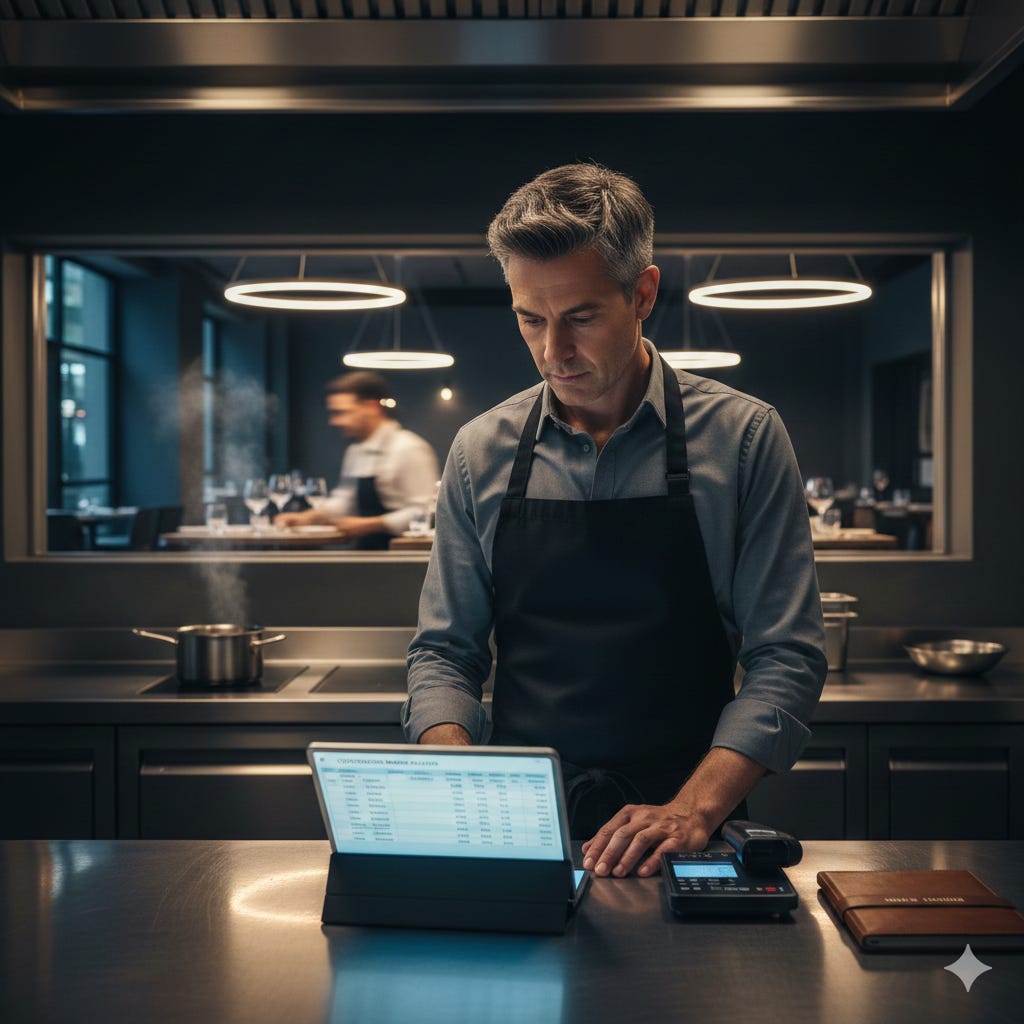
The Three Levers You Need to Be Working in Your Restaurant in 2026! Or: Why You Know What to Do and Still Don’t Do It
Some restaurants are making more money this year than last.
Not the ones you’d expect. Not the ones with the biggest Instagram following or the James Beard semifinalist in the kitchen. Not the ones that just raised $2 million or opened their third location.
The ones making money are the ones who figured out profitability isn’t one thing. It’s three core levers. Most operators know all three.
They just don’t work them.
Labor costs are up 21% to 50%, according to TouchBistro’s 2026 Restaurant Labor Report. Tariffs disrupted supply chains in 82% of metro areas. Black Box Intelligence tracked four straight months of declining traffic through November 2025. Consumers are tired. They’re trading down or staying home.
You already know this. You’re living it.
What you might not know is that the operators making money aren’t smarter than you. They’re not working harder. They’re not buying better software or hiring better consultants.
They’re doing the things you already know how to do but keep putting off because you’re too busy, too stressed, or too convinced that your situation is different.
It’s not different. Here’s what’s stopping you.
Lever 1: Menu Engineering for Contribution, Not Food Cost Percentage
What You Already Know
Your POS says the burger has a 28% food cost. The salad has a 32% food cost. So you promote the burger.
You know this is wrong. Deep down, you know it.
A $28 burger with 28% food cost puts $20.16 toward labor and overhead. A $14 salad with 32% food cost puts $9.52 toward the same things.
Three salads don’t equal one burger.
You’ve heard this before. Someone explained contribution margin to you at some point. Maybe a consultant. Maybe a chef you respect. Maybe a webinar you half-watched while doing prep.
You nodded. You understood. You went back to promoting the burger.
Why You’re Not Doing It
The math feels like homework, and you got into this business to cook, not to run spreadsheets.
Food cost percentage is easy. Your POS spits it out. You look at it once a week, maybe once a month. You see a number. You make a decision.
Contribution margin requires pulling your top 20 sellers. Building a spreadsheet. Calculating dollars, not percentages. Seeing which dishes carry the business and which ones just look good on paper.
It’s two hours of work. Maybe three if you haven’t done it before.
You don’t have two hours. You have a wine rep waiting. A health inspector is coming on Thursday. A line cook who just called out sick. A Yelp review that’s making you want to throw your phone into the fryer.
You keep running the menu you’ve always run. You keep promoting the items with the lowest food cost percentage. You keep wondering why you’re working harder and making less.
Here’s what happens when you do the math:
Riviera Produce analyzed protein-forward menu engineering using contribution margin in their 2026 profit strategies report. The operators who rebuilt menus around contribution found that dishes they thought were profitable were bleeding money. They found dishes they almost cut were carrying the entire operation.
A $24 entrée with 45% contribution margin is positioned where eyes land first. A $16 appetizer bundle, protein, high-margin side, beverage, that feels like a deal but carries $9 of margin. That’s engineering.
You have to stop promoting based on food cost percentage. You have to do the math. You won’t. Stopping feels like losing.
The other thing you know but aren’t doing is that smaller menus that change more often.
38% of operators moved to smaller, more frequently rotated menus, according to TouchBistro. The James Beard Foundation’s 2026 food trends report found operators building menus around what’s fresh, what’s local, what feels right for the season.
You know this works. You’ve seen it work. You’ve eaten at restaurants that do it and thought, “I should do this.”
You don’t do it because your regulars expect the burger. Your Yelp reviews mention the pasta. You’ve got 10,000 menus printed, they cost $800, you’re not throwing them out.
You keep running the same 47 items you’ve run for three years. Half of them don’t sell. The ones that do sell are profitable by accident, not design.
When you’re buying six proteins instead of twelve, you buy twice as much of each. Your vendor gives you better pricing. Your line cooks get faster because they’re not context-switching between twelve different prep sequences. Your waste drops because you’re not throwing out the thing nobody ordered this week.
You have to cut the menu. And cutting the menu feels like admitting defeat.
Lever 2: Throughput Is The Profit Machine You’re Ignoring
What You Already Know
Throughput is about removing friction.
The moment between when a guest orders and when the food hits the table. The moment between when they finish and when the check arrives. The moment between when they pay and when the table gets reset.
You know this matters. You’ve done the math in your head. A restaurant that seats 80 covers in a three-hour window versus 60 covers in the same window makes more money. A table that turns from guest exit to re-seat in 12 minutes versus 20 minutes adds roughly 30% more revenue per service.
You see it. You watch tables sit empty for 15 minutes after guests leave because your busser is in the weeds, and nobody else is helping.
Why You’re Not Doing It
Fixing throughput requires changing the culture. Changing the culture requires confrontation.
Your host seats a four-top at 7:15 pm even though the two-top next to it is still waiting for dessert. You see it happen. You know it’s wrong. You know it’s killing your turns.
Your host is good at their job most of the time. They smile. They answer the phone. They don’t call out. You don’t want to make it a thing.
You don’t say anything. It keeps happening.
Your servers don’t pre-bus. They drop the mains and walk away. They come back 10-minutes later when the guests are done. By then, the guests have been sitting with dirty plates for 8-minutes. They’re annoyed. Your turn time is shot.
You’ve trained them. You’ve reminded them. You’ve probably yelled about it after a bad Saturday.
They keep doing it. Pre-bussing feels like extra work. They’re already carrying three tables, a four-top that just got sat in their section, and they don’t have time.
They don’t do it. You let them not do it. Firing someone over pre-bussing feels petty when you’re short-staffed, it’s February, nobody’s applying.
28% of operators report using tech or revised workflows to improve speed, per TouchBistro. Tech doesn’t fix throughput if your workflow is broken. Tech amplifies what you already do.
If your expo is calling tickets wrong, a $3,000 KDS system won’t save you. It’ll just make you call tickets wrong faster.
When throughput works, your host doesn’t seat a four-top at 7:15 pm when the two-top next to it is still waiting for dessert. Your server pre-buses appetizer plates when they drop the mains, not after the guests finish eating. Your bartender runs a credit card while pouring a drink, not after. Your busser knows which tables are close to turning and stages them in their head.
None of this is complicated. All of it’s deliberate.
Deliberate requires standards. Standards require enforcement. Enforcement requires you to have uncomfortable conversations with people you like who are otherwise doing fine.
You don’t have the conversations. Your throughput stays stuck.
A restaurant that optimizes throughput by 15%, through speed, turns, or attachments, improves contribution dollars without a price increase. Restaurant Dive reported beverage and dessert attachment as margin drivers without aggressive upselling in their 2026 trends analysis.
Guests won’t feel it. They’ll remember coming back. You have to have the conversations first.
Lever 3: Waste Elimination and Ingredient Accuracy
What You Already Know
In the average restaurant, 4% to 7% of food cost is pure waste. Spoilage. Prep loss. Over-plating. Remakes from miscommunication. Consolidated Concepts reported this range in their multi-unit restaurant strategies report.
If your COGS is $400,000 per year and waste is 5%, you’re bleeding $20,000 on problems that don’t show up clearly in reports.
You see it. You’ve seen the arugula wilt. You’ve watched line cooks plate dishes too generous. You’ve eaten remakes yourself at the end of the night because you’re not throwing out a $32 steak.
Why You’re Not Doing It
Tracking waste feels like admitting you’re bad at your job.
42% of operators identified waste reduction as their primary strategy for managing inventory costs in 2026, according to TouchBistro. They buy from vendors with detailed specs. Size counts. Ripeness windows. Pack sizes that match prep.
Every station has a photo of the correct plate. Not as a suggestion. As the standard.
Every void, every remake, every plate that comes back gets logged by item in their POS. Not as an audit. As a leading indicator.
You’re not doing any of this.
Why? Logging remakes means admitting you have remakes. Taking photos of plated dishes means admitting your line cooks don’t know what the dish is supposed to look like. Calling your vendor about specs means admitting you’ve been accepting whatever shows up.
All of that feels like failure.
You don’t track it. You absorb it. You write it off as “part of the business.” You tell yourself waste is normal and there’s nothing you can do about it.
I know a chef in Bothell who started logging remakes by station and daypart. Three weeks in, he noticed his garde manger was remaking salads every Tuesday and Wednesday between 6 and 8 PM. Not Monday. Not Thursday. Tuesday and Wednesday.
He didn’t want to look at this data. He already knew his garde manger was weak. He was planning to fire him after the holidays when he could find someone better.
He looked. What he found wasn’t a people problem. It was a process problem.
His produce vendor delivered on Mondays. By Tuesday night, the arugula was starting to wilt. By Wednesday, it was worse. By Thursday, they’d used it all and moved to the next case.
He moved the delivery to Tuesday. Remakes dropped to near zero. Saved $400 a month on a single menu item. His garde manger got better overnight because the arugula wasn’t fighting him.
That’s what tracking gets you. Information!
You have to be willing to look at the information. Most operators aren’t. The information makes them feel stupid for not seeing it sooner.
A restaurant that reduces waste by 2% improves its food cost from 32% to 30%. No price increases. No supplier changes. For a $2 million restaurant, that’s $40,000 in margin.
You could have that $40,000. You’d rather not know where it’s going.
Why This Matters
These three levers don’t work alone.
A menu engineered for contribution doesn’t matter if your throughput is so broken that guests leave before dessert. Throughput gains disappear if you’re bleeding 5% of COGS to waste. Waste reduction means nothing if you’re promoting low-margin dishes.
You know this. You’ve always known this.
What you don’t know is why you’re stuck.
You’re stuck because you’re waiting for things to calm down before you fix anything. You’re stuck because you think your situation is unique. You’re stuck because fixing these things requires confronting the fact that you’ve been doing them wrong.
The restaurant industry in 2026 sits at an inflection point. Tariff disruption is real. Labor is tight. Consumers are tired.
Winners aren’t the ones absorbing costs passively. They’re the ones looking at their business operationally. Where money goes. Where it gets stuck. Where small changes compound.
You don’t need a consultant or a $50,000 software investment.
You need two hours on a Monday morning when you’re closed. You need a spreadsheet. You need to look at your top 20 sellers and calculate contribution. You need to log remakes for two weeks. You need to have one uncomfortable conversation with your host about seating strategy.
None of this is complicated. All of it requires you to stop moving long enough to think.
That’s what you won’t do.
Stopping feels like losing. Thinking feels like weakness. You got into this business to cook, to create, to build something, not to sit in an office with a spreadsheet calculating margin on a burger.
The truth is that the restaurants thriving in 2026 aren’t the ones cooking better food. They’re not the ones with better locations, better concepts, better marketing.
They’re the ones who stopped long enough to fix the things everyone knows are broken.
You’ll read this and agree. You’ll think about doing it on Monday. Monday, you’ll have a delivery issue. Tuesday, the POS will go down. On Wednesday, your best server can’t come in because of a sitter issue. By Friday, you’ll have forgotten you ever read this.
I know because this is what I was doing, and this is what I’m doing now. I lived this.
The bar is lower than you think. Which means most of your competition won’t clear it.
Not because they can’t. Because they won’t.
The question is, “Will you?”
#RestaurantOperations #HospitalityManagement #RestaurantProfitability #FoodCost #MenuEngineering #RestaurantIndustry #HospitalityLeadership #RestaurantOwners
If this made you think of someone, send it to them. If it pissed you off, tell me why. Follow along for free if you’re tired of reading advice you already know and want someone to tell you why you’re not taking it.