
The Manager’s Playbook: Running a Smooth Weekend Brunch Service

The Manager’s Playbook: Running a Smooth Weekend Brunch Service
Your brunch shift will fail if you think it runs itself.
I have worked brunch at a 100-seat neighborhood joint and a 250-seat hotel restaurant. I have seen managers seat every table by 10:15 am because they didn’t want to say no. Ticket times climb to forty minutes. Servers apologize to tables who came for a quick meal before a wedding. Guests walk out angry. Staff break down in the dish pit. Cooks throw tickets across the line because the printer won’t stop.
Most of it was preventable.
The problem isn’t your menu. The problem isn’t your staff. The problem is seating guests faster than your team can serve them. Once that train leaves the station, you can’t get it back on track.
The Math Doesn’t Lie
Your team can take care of a certain number of people every fifteen minutes. That number is fixed by how many servers you have, how many seats each server can manage, how fast your kitchen’s line can turn tickets during peak volume.
Let’s say you have three working on the line at brunch. If you can only produce 25-entrees every 15-minutes with great ticket times, you shouldn’t seat more than that every 15-minutes. That’s 100 guests per hour. If you seat 120 guests between 9:30 am and 10:30 am, even if you spread them out, at least 20-people are going to have a bad experience. On the road, you can’t go faster than the car in front of you. In the restaurant, you can’t seat faster than the kitchen can cook. Their food will be slow. Their server will be stressed and challenged to keep winning over the guests. They’ll leave upset. They’ll tell people.
Brunch guests are less forgiving because they have somewhere to be. A ballgame. A show. A meeting. A family event. They’re on a schedule. Every online review platform shows the same pattern. Slow service complaints spike during weekend brunch. Not because the service is worse. Because the stakes are higher.
You can’t serve your way out of being overseated.
The Hotel Problem
At the 90-seat local spot, we knew our flow. Regulars came at 9 AM. Families hit at 10:30 AM. The after-church crowd rolled in after. We could predict it and staff accordingly.
The hotel restaurant was chaos.
You may not know what events are feeding guests in-house. You don’t know what deals the hotel’s sales team made with a corporate group because we weren’t operated by the hotel. You don’t know if a wedding party of 60 is going to walk in at 8 am or 10 am, expecting tables, because the sales lead was vague. You staff based on your understanding of past local events, and what knowledge you have of the different groups in the hotel, what you normally average. You pray you guessed right.
Some Sundays, we stood around folding napkins. On other Sundays, we got crushed.
The key wasn’t trying to be perfect. The key was controlling what we could control once service started. That meant controlling the door.
Seat Control is Everything
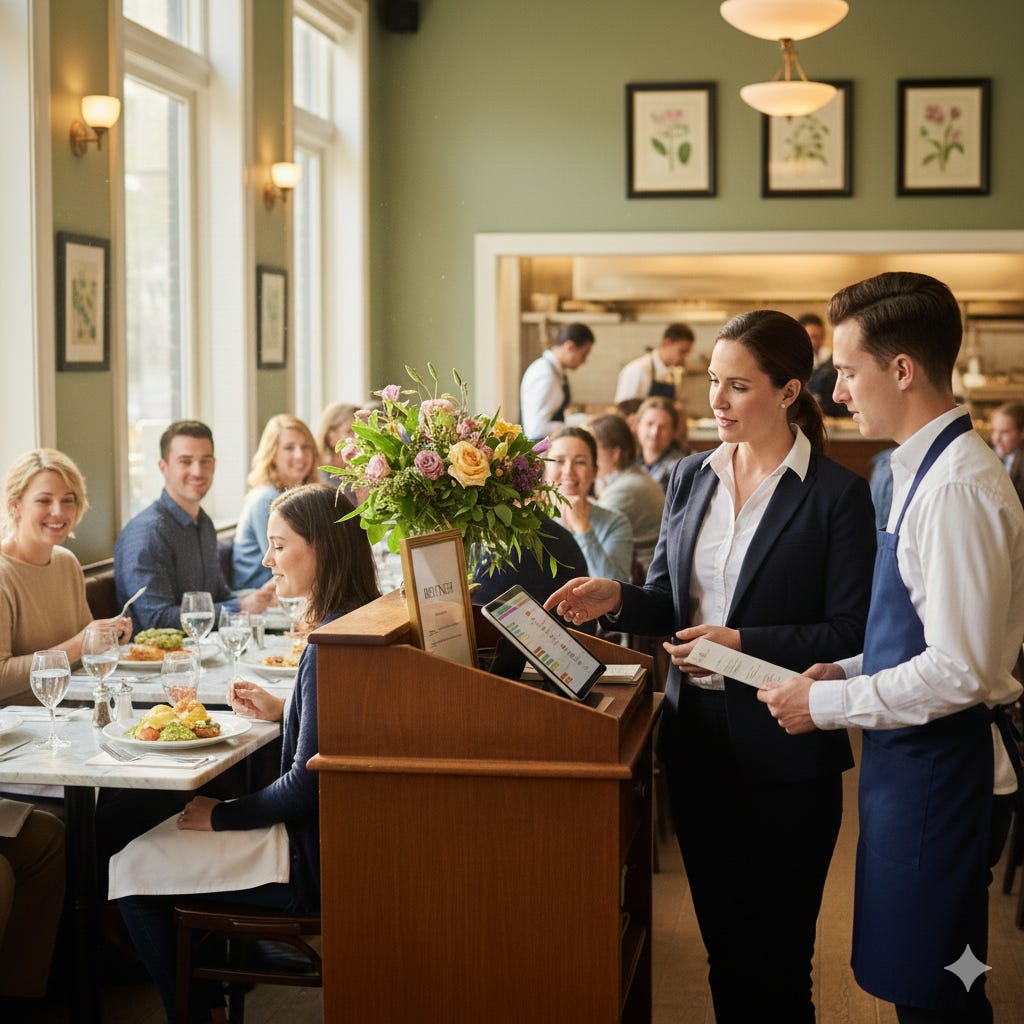
The host stand is the most important position in your restaurant during brunch. The host controls the flow. The host protects your seated guests.
When I managed brunch, I stood at the host stand during peak hours. Not because I didn’t trust my host. Because the host needed backup when guests got angry about the wait.
I tell every host that their job isn’t to fill tables. Your job is to protect the guests already seated. This means following our system and only seating 25-guests every 15-minutes. It means adapting if your servers are in the weeds, you slow or stop the door. If ticket times are pushing past 25-minutes, you slow seating, adjust the wait.
You quote a wait. You offer coffee while they wait. You take their name. You make them feel seen and comfortable. You don’t put them in a chair until your team can take care of them.
Guests who wait 15-minutes, who get great food and service, leave happy. Guests who sit immediately and wait 40-minutes for food leave angry. Do the brutal math.
Prep Or Die
Your prep cooks should spend Thursday and Friday setting up for the weekend. Not just prepping ingredients. Setting up systems.
Perhaps, pre-crack your eggs if you’re running an omelet station. Pre-cut your vegetables for scrambles and hashes. Make your Dutch Baby batter. Get your bacon par-cooked and ready to finish.
Then think about shelf life. Hollandaise holds for four hours. Pre-cracked eggs last two days. Your hash components can be prepped three days out, if labeled and stored correctly.
We made a prep sheet every Thursday that mapped every item on the brunch menu to a shelf life and a prep day. Nothing got prepped too early. Nothing got prepped too late. The walk-in was organized by expiration date. Cooks grabbed and went. You check and revise Friday, Saturday, Sunday.
I watched restaurants throw away hundreds of dollars in spoiled prep because someone did too much vegetable prep on Wednesday, and it was past its shelf life by Saturday. I watched other places scramble to prep during service because they didn’t start early enough.
Get it wrong, and you pay for it all weekend.
The Pre-Shift Isn’t Optional
I aspire to hold a pre-shift before every brunch service. Same time. Same spot. Every week. Everyone standing in a circle near the expo line before the first ticket dropped.
Specials and 86’d items. Any changes to the floor plan. Who is working in which section. Who is the go-to if someone gets slammed. Any large parties or reservations coming in. Any VIPS. Any prep concerns from the kitchen. What to push for the shift.
I skipped pre-shift once because we were short-staffed and I was running around trying to fix it. By 10 am, one server was seated a surprise twelve-top with no warning. The kitchen 86’d Eggs Benedict at 11 am, because we ran out of prepped hollandaise. Half the floor didn’t know until guests ordered it.
The pre-shift forced everyone to stop, look up, and remember we were a team. That mattered when service got hard.
Mise-En-Place And Backup Plans
Your line cooks need to arrive two hours before service starts. Not to cook. To set up their stations and think through what happens when they run out.
Every station should have a backup plan for its three most-used items. If you run out of hollandaise mid-service, what do you do? If you run out of bacon, where is more? If you run out of hash browns, can you pivot to a side of fruit?
At the hotel, we kept a Cambro of backup hollandaise ingredients in the walk-in during service. We kept extra bacon in the warming drawer. We kept extra eggs already cracked and ready.
The moment a cook ran low on something, they called it out. The chef or sous chef grabbed the backup. No one stopped cooking to run to the walk-in during a rush. No tickets died on the rail.
This sounds obvious. I’ve seen restaurants go down because the line ran out of hollandaise at 11 am and spent ten minutes digging through the walk-in, and more time blending it, while the printer screamed and tickets piled up.
Cross-Train Your Kitchen
The best kitchens I worked in had prep cooks who could step onto the line.
When we got slammed, the chef or sous chef pulled prep cooks, put them on eggs or plating. They didn’t have to be perfect. They had to keep food moving.
This meant cross-training everyone. Prep cooks spent time on the line during slow services. Line cooks rotated through stations. Everyone learned the flow.
Without it, you’re one callout away from disaster. One sick line cook, your whole service could collapse, or you reduce the number of guests you seat every 15-minutes, because no one else knows the station.
A prep cook who can crack eggs and flip an omelet is worth twice their hourly rate during a rush. A dishwasher who can plate desserts saves you when you’re buried.
Train your people. Pay them for the extra skills. Use them when it matters.
The Manager’s Role During Service
The manager doesn’t stay in the office. The manager is on the floor, watching the flow, making adjustments in real time.
I spent brunch moving between the host stand, the expo line, the kitchen, the floor. I watched ticket times. I watched server faces. I watched the door.
When ticket times hit twenty-five minutes, I slowed seating, adjusted the wait. When a server looked overwhelmed, I ran their food or bussed their tables. When the kitchen got backed up, I helped expo, or made the dish or two I could do. Sometimes you have to wash dishes.
New managers think their job is to manage from a distance. Your job is to be in the middle of it.
You can’t fix problems you don’t see.
The One Thing That Matters Most
I learned, after hundreds of brunch shifts, that you focus on the guests who are already seated.
Give them great food. Give them great service. Even if it means people at the door wait.
A guest who waits and then has a great meal comes back. A guest who sits immediately and gets ignored doesn’t.
Every decision I made during brunch came back to that principle. When I had to choose between seating another table or helping a server who was drowning, I helped the server. When I had to choose between filling the dining room or protecting ticket times, I protected ticket times.
The guests in your building are your responsibility. The guests at the door aren’t your responsibility yet.
Delay the seating. Control the flow. Protect your team. Serve the people you have before you serve the people you want.
That is how you run a smooth brunch.
#RestaurantManagement #BrunchService #HospitalityLeadership #RestaurantOperations #KitchenManagement #ServiceIndustry #RestaurantLife
I’ve worked thousands of services. If you’re managing brunch or thinking about stepping into it, follow along for free. Connect with me here. I want to hear what is working for you and what is breaking your back.