
The First Three Steps To Training Your FOH Staff Aren’t What You Think

The First Three Steps To Training Your FOH Staff Aren’t What You Think
You think training starts with a handbook. Or a video. Or a speech about hospitality.
It starts with a question: Do they trust you yet?
Most restaurant owners walk into training with brand new hires and 10-year veterans in the same room and wonder why nothing sticks. They hand out checklists. They talk about upselling. They demonstrate how to carry three plates. Then they watch the whole thing fall apart on Friday night.
The problem isn’t the content. The problem is you skipped the foundation.
Here is what happens when you skip it. The new hire doesn’t know if you see them as temporary labor or as someone worth investing in. The veteran doesn’t know if this training session is a real change or just another performance. Nobody learns when they’re guessing where they stand.
Training Front of House staff isn’t about teaching people to smile or memorize specials. It’s about building a crew that functions under pressure and protects your reputation when you’re not in the room. That starts with three specific steps. They’re not flashy. They work.
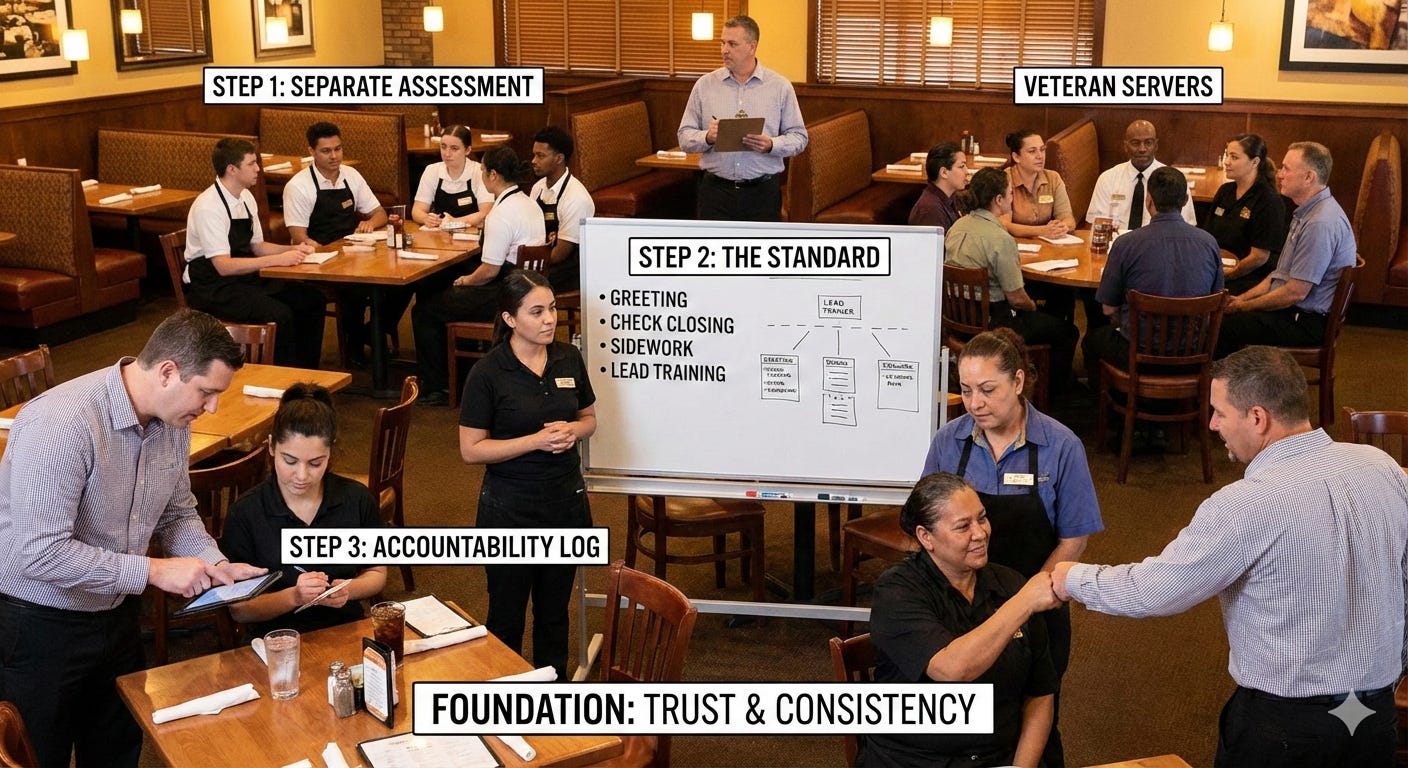
Step One: Separate Assessment From Instruction
You don’t know what people know until you watch them work. You don’t know what they need until you see where they break down.
Bring everyone together. New hires and veterans. Then split them immediately.
Your veterans don’t need to sit through basics. Your new hires don’t need to feel lost while you reference systems they have never seen. Mixing skill levels in early training wastes time and credibility.
Assess the new hires first. Put them on the floor during a quiet service or run a mock shift. Watch how they greet a table. Watch how they handle a question they can’t answer. Watch how they move through space when it gets tight. Don’t correct them yet. Just observe.
Do the same with your veterans, but the assessment is different. You’re not watching for competence. You’re watching for gaps, bad habits, and whether they still care. A server who has been with you for three years might be excellent at reading a table but terrible at closing. They might be warm with regulars but dismissive with first-timers. You need to see it before you address it.
Write it all down. Every weak point. Every strength. Every question that goes unanswered.
Now you know what to train.
Step Two: Build the Standard, Then Defend It
You don’t have a training problem. You have a standards problem.
If your veterans are doing things differently from how you want your new hires to do them, you don’t have a system. You have chaos with seniority.
Sit down and write out exactly what “right” looks like. Not vague stuff. Specific stuff.
How do you greet a table? Word for word, if necessary. What do you say when someone asks if the fish is fresh? What do you do when a guest is rude? When do you call for a manager? How do you close a check? What does sidework look like when they say they have completed it?
This isn’t micromanagement. This is clarity.
Then you bring everyone back together. Veterans and new hires. You tell them this is the standard now. You explain why it matters. You show them how it protects them, how it makes their job easier, how it ensures the guest gets the same experience no matter who is working.
Your veterans will resist if they think you’re fixing something that isn’t broken. Don’t argue. Show them the data. Show them the Google reviews that mention inconsistency. Show them the ticket times. Show them the tip averages. Make the case with evidence, not opinion.
Retention improves when people know exactly what is expected and see that the rules apply to everyone. The operators who survive the current labor crisis are the ones who stopped guessing and started documenting.
Then you train to the standard. You demonstrate. You role-play. You let people ask questions. You make sure everyone leaves that room knowing exactly what you expect and why.
Step Three: Install Accountability Before You Walk Away
Training without accountability is theater.
You can’t train people once and hope it sticks. You can’t assume they’ll remember. You can’t rely on goodwill or work ethic to keep standards high when the rush hits, or when nobody is watching.
You need a system that holds people to what they just learned.
This is where most operators fail. They train well. Then they go back to putting out fires and assume the training will take root on its own. It doesn’t.
Install a simple observation and feedback loop immediately. Not a month from now. Not after the next scheduling period. Immediately.
Assign a lead server or manager to shadow each new hire for their first five shifts. Not to babysit. To observe and correct in real time. When the new hire forgets to pre-bus, you stop them and fix it right then. When they nail the greeting, you tell them. When they skip a step in closing sidework, you walk them through it again.
For your veterans, the accountability is different but equally important. You check their work the same way you check the new hires. If they revert to old habits, you pull them aside and remind them of the standard. If they’re doing it right, you acknowledge it.
This isn’t punishment. This is consistency.
Your team will test the standard. They’ll see if you mean it. If you let it slide once, you lose all of it. If you enforce it fairly and consistently, you build a culture where people know the rules matter and the work matters.
People stay when they feel competent and supported. They leave when they feel confused or overlooked. The restaurants that reduced early turnover did it by pairing structured onboarding with consistent feedback in the first 90 days.
Set a 30-day review for every person who went through training. New hires and veterans. Sit down with them one-on-one. Ask them what is working. Ask them what is hard. Tell them where they’re strong. Tell them where they need to improve. Make it clear that this isn’t a one-time conversation.
Then do it again in 60 days. Then again in 90 days. Then every six months. By then, the standard is embedded. People know what is expected. They know you’re watching. They know you care enough to invest the time.
What Happens Next
Training FOH staff isn’t complicated. It’s relentless.
You assess before you teach. You define the standard before you expect people to meet it. You follow up before you assume they remember.
Most operators skip these steps because they’re in a hurry. They need bodies on the floor. They need someone to cover a section. They need the night to go smoothly. So, they throw people into service and hope for the best.
Hope isn’t a strategy.
The time you invest in these three steps pays back every single shift. You get consistency. You get confidence. You get a team that knows what they’re doing and why it matters.
When the rush hits and the kitchen is in the weeds, and a table is upset, and you’re not there to fix it, your team handles it. You trained them. You held them to it.
That is the whole point.
#RestaurantLeadership #FOHTraining #HospitalityManagement #RestaurantSystems #ServiceStandards #TeamTraining
If you want more straight talk about building restaurant systems that survive the rush, follow along for free. I write for people who are done pretending everything is fine.
Hi, David. Thank you very much for today's article about FOH training. You've hit the proverbial nail on the head, especially highlighting the distinction between defining the standard and actually defending it over time.
What resonates with us in this work is that every one of these steps you've laid out -- assessment, standards, and accountability -- tends to fail not because operators don’t know what to do, but because the systems rely too heavily on the same few people being present every shift. And with high turnover a perennial challenge for restaurant owners, one has to wonder how they can successfully train their teams at all given all the "coming and going."
Assessment, for example, often happens informally and then disappears. Standards live in someone’s head, a binder, or a checklist that no one looks at mid-service. Accountability depends on whether the right manager is available in the moment.
We’ve been looking at how technology can support these exact steps without replacing the human side of hospitality. Our goal has been to keep standards accessible in real time, reinforce them consistently regardless of who’s working, and provide a simple way to check progress without adding more manager overhead. The knowledge still comes from the team, and the system just helps hold onto it and make it usable under pressure.
Appreciate how clearly you laid out the foundation here. The owners and managers who get this right are the ones building systems that can actually survive a Friday night.