
Review Bombing: When Extortion Comes to Your Door

Review Bombing: When Extortion Comes to Your Door
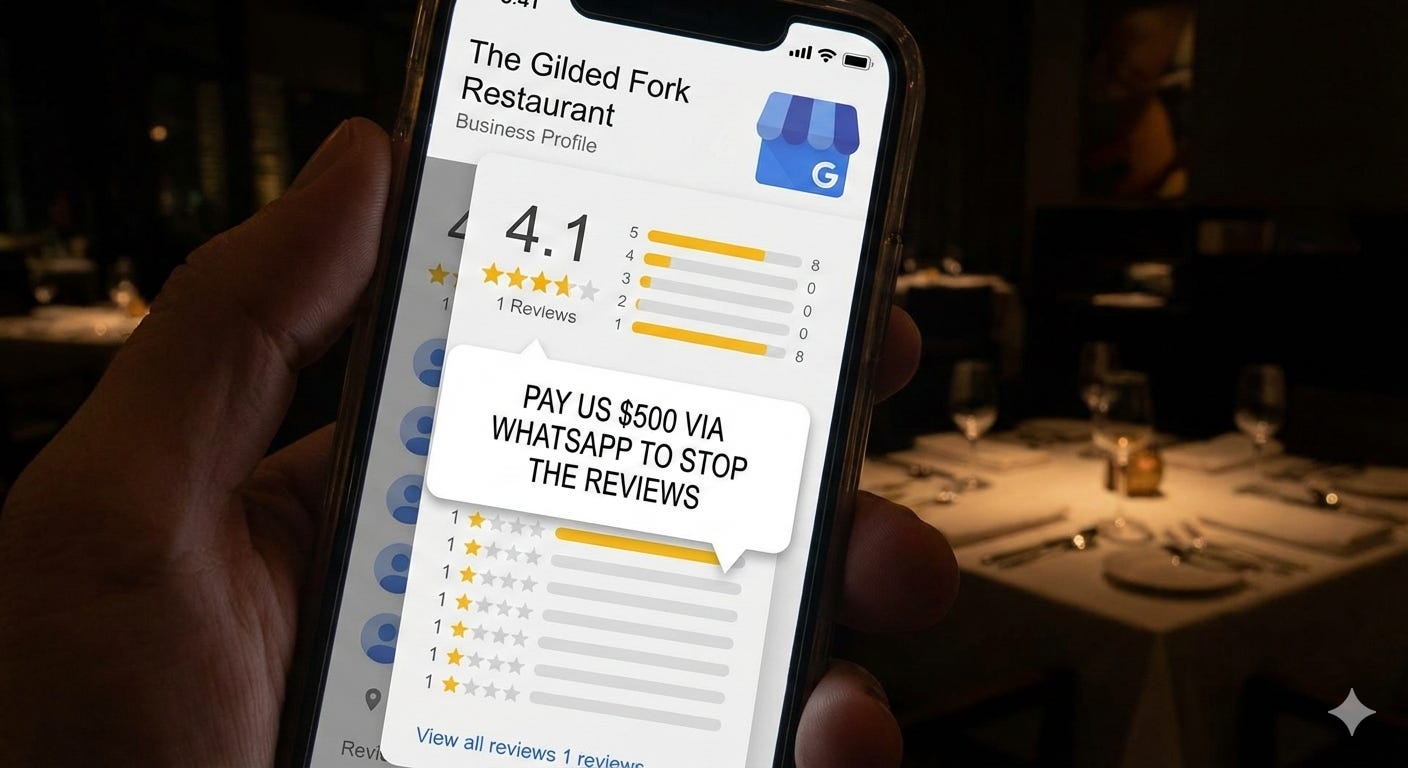
You open your phone. 20 one-star reviews in three hours. Your restaurant rating drops from 4.5 to 4.1. Then comes the WhatsApp message demanding $500 to make them stop.
Welcome to 2026, where your online reputation isn’t just fragile. Someone else holds the matches.
The New Ransom Business
Alpana in Chicago got hit on November 15, 2024. Fifty fake reviews in one night. Owner Alpana Singh, a master sommelier and former host of “Check, Please!” watched her Google rating crater. Singh called the ratings drop “a death blow for restaurants.”
The scam follows a pattern. Fraudsters flood your Google Business Profile with one-star reviews. The complaints sound generic. Chicken was raw. Service was terrible. Bathroom was dirty. None of these people ate at your restaurant. Then the message arrives through WhatsApp or Telegram. Pay us, or we keep going.
SHŌ, an omakase spot in Chicago’s Old Town, got hit four months after opening. Owner Adam Sindler said at least 20 reviews rolled in over three to four hours. The restaurant seats twelve people at a time. The math doesn’t add up. The fear does.
What You Lose in Numbers
A Harvard Business School study analyzed Yelp data from Seattle restaurants between 2003 and 2009. A one-star increase in Yelp rating leads to a 5% to 9% increase in revenue for independent restaurants. Work the equation backwards. A drop from 4.5 to 4.1 means you lose customers before they walk through the door.
33% of restaurant-goers won’t eat at a restaurant with a 3-star rating. Your restaurant lives or dies in the space between 3.5 and 4.5 stars.
Protein Bar & Kitchen in Chicago experienced this on Halloween 2024. COO Jared Cohen watched notifications pile up. The reviews started coming in fast, and after two or three, Cohen realized something was wrong. The reviews were identical. The pattern was obvious. The damage was real.
Review bombing clusters hit Philadelphia and Chicago this fall. Illinois Restaurant Association CEO Sam Toia says the attacks increased over the past six months, targeting mid to upscale restaurants. The scammers know where the margins are thin. They know where desperation lives.
Google’s Late Response
For years, restaurants had no defense. Google’s review removal process was slow. Business owners filled out forms. Nothing changed. For many businesses, paying the ransom was easier.
Google launched a merchant extortion report form in November 2024. The form creates a direct channel to Google’s Trust and Safety team. Restaurants submit evidence. Screenshots of demands. Links to fake reviews. Email threads. WhatsApp messages.
The form has shown results. Google removed negative reviews about SHŌ within a week. One local SEO professional reported removal within days after filing. The system works when restaurants document everything and act fast.
The form requires proof of extortion. A ransom demand. A threat to continue. Without those messages, you’re back to the old system. Flag reviews one by one. Wait. Hope.
What To Do When They Come
Don’t pay. Paying proves the scam works.
Don’t engage. No negotiation. No counter-offers. Silence.
Document everything immediately. Screenshot every message. Note timestamps. Capture sender details. Email addresses. Phone numbers. Social media handles. Gather this before reporting.
Report through the merchant extortion form. Include all evidence. Provide links to every suspicious review. Detail when the first demand arrived. Explain how the attack unfolded.
Preserve the records. Law enforcement needs documentation. Google needs it. You need it when the next wave hits.
Restaurant owner Ryan Fakih at Beity received fake Google reviews that were nearly identical to those hitting another Old Town restaurant. The scammers aren’t creative. They copy and paste. They use templates. These patterns help Google identify and remove attacks faster.
The Second Kind of Bombing
Not all review bombs come from extortionists. Some come from angry mobs. A restaurant makes a political statement. Posts vaccine requirements during COVID-19. Supports Black Lives Matter. Takes a stance.
The reviews flood in from people who never ate there. Will B. Payne, assistant professor of geographic information science at Rutgers, studied review bombing incidents between 2004 and 2021. His research shows two patterns.
Comet Ping Pong in Washington, D.C., faced attacks from across the country. Review bombing resulted in comments from reviewers mostly on the West Coast, thousands of miles away from the restaurant. Yelp removed the reviews. The platform protected the business.
Pi Pizzeria in St. Louis got different treatment. Owner Chris Sommers marched with protestors against police violence. Local customers left reviews thanking him for standing with the community. Of the 588 Pi Pizzeria reviews that Yelp removed, most were in support of his actions, positive reviews that averaged close to the restaurant’s four-star rating. Yelp censored support.
The platforms struggle to separate legitimate community response from coordinated attacks. Automated systems read patterns, not context. Human reviewers make judgment calls. Sometimes they get it wrong.
The Reality Check
Adam Sindler said anytime you’re a new restaurant, you’re an easy target for people because you don’t have a built-in audience or individuals who know who you are. Scammers hunt the vulnerable. New openings. Small operators. Places without hundreds of reviews to cushion the blow.
The Illinois Restaurant Association advises members to avoid engaging with extortionists. Sam Toia recommends customers ask family and friends about their experiences or check suggestions on neighborhood chamber of commerce sites rather than rely on star ratings. Good advice. Hard to follow when everyone searches Google first.
The game changed. Reviews were feedback. Now they’re weapons. Restaurants need response plans before the attack comes. Designate someone to monitor reviews daily. Set up alerts for new postings. Know where the extortion form lives. Save the link. Brief your team.
Speed matters. The longer fake reviews stay live, the more damage they cause. The faster you document and report, the faster Google acts.
What the Industry Lost
Restaurant criticism used to mean something. Singh noted that when Tribune restaurant critic Phil Vettel gave you three stars, you were packed for a year. Professional critics had standards. Training. Ethics.
Social media influencers replaced professional critics. Anyone with a phone becomes a food writer. Some are honest. Many chase free meals. A few run extortion schemes.
The trust gap widens. Diners don’t know what reviews to believe. Operators don’t know which feedback is real. Platforms move too slow. Everyone loses except the scammers.
The Action Plan
Monitor your Google Business Profile daily. Set up review alerts. Check your rating every morning.
Create a response protocol. Who handles review issues? What steps do they follow? Write it down. Train your team.
Save the merchant extortion form link now. Bookmark it. Don’t wait until you need it.
Build your review base before trouble starts. Ask satisfied customers to leave honest feedback. A restaurant with 300 reviews weathers attacks better than one with thirty. The numbers protect you.
Respond to all reviews professionally. Real customers see how you handle criticism. Your response matters more than the complaint. Stay calm. Take responsibility when appropriate. Explain what you’ll fix.
Document suspicious patterns immediately. Sudden review spikes. Generic complaints. Profiles with no history. Screenshot everything. You might need proof later.
Never pay. Never negotiate. Never engage with extortionists. Report and move on.
The review bombing problem will get worse before it gets better. Scammers see easy money. Google’s response came late. The damage to small businesses piles up daily.
Your defense starts with knowledge. Know the threat. Know the process. Know what to do when your phone starts buzzing with one-star reviews at midnight.
The restaurant business was hard enough before criminals turned your reputation into ransom. Now you need a security plan for something outside your control. Document everything. Trust nothing. Stay ready.
#RestaurantManagement #OnlineReputation #ReviewBombing #HospitalityIndustry #RestaurantSecurity #GoogleReviews #RestaurantOperations #DigitalExtortion
Want the hard truth about running restaurants without the fluff? Follow me for free dispatches from the line.