
Marco Pierre White Returning His Michelin Stars Taught Me More About Leadership Than Any Management Course I Ever Took

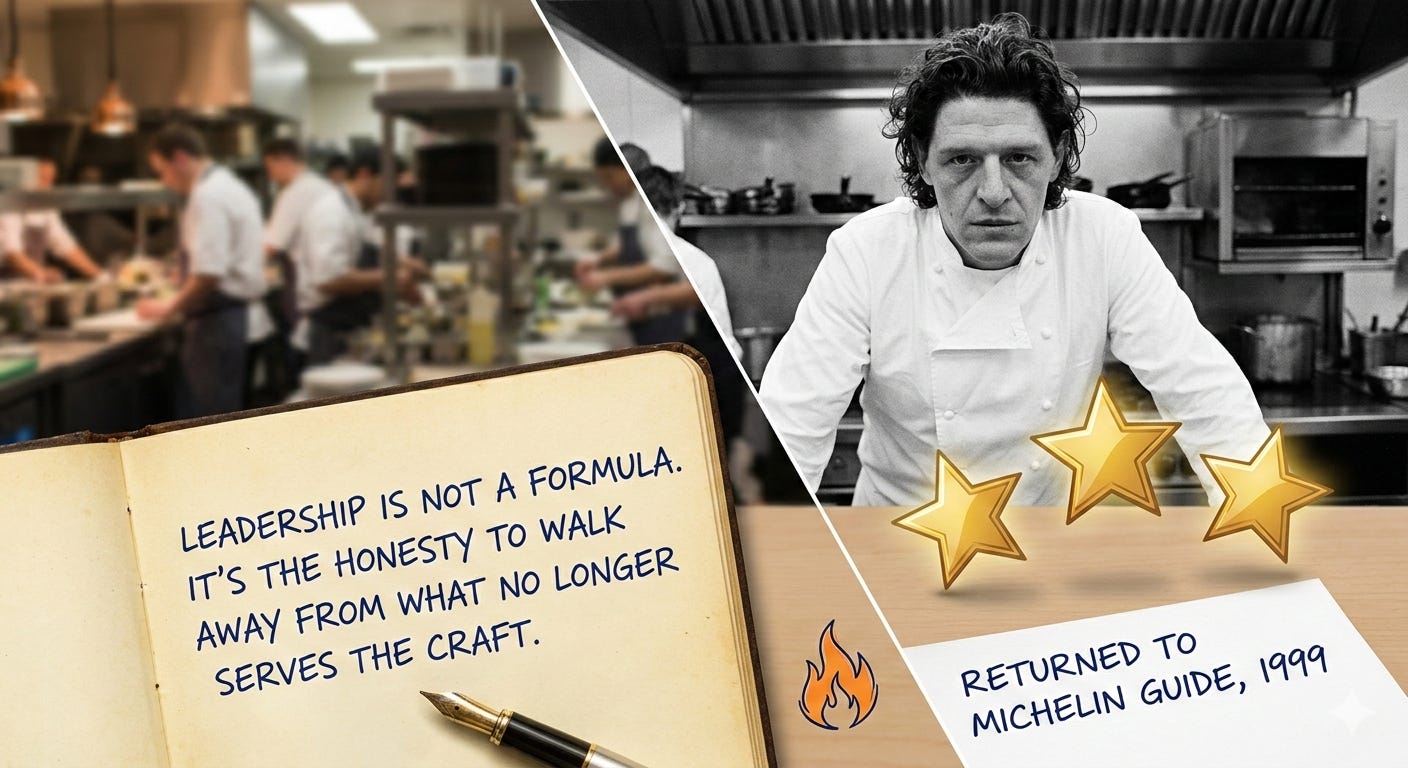
Marco Pierre White Returning His Michelin Stars Taught Me More About Leadership Than Any Management Course I Ever Took
It was a Saturday night. We were running a tight ship. Numbers were clean. The regional director had walked through two weeks earlier and said everything looked good. Yet I was empty inside.
I didn’t know what to do with that. You’re supposed to feel something when it’s working. I kept thinking I was just tired.
Marco Pierre White felt something similar in 1999. He had three Michelin stars, the highest distinction in the culinary world, earned at 32 years old. The youngest chef in history to get there. The first British chef to ever do it. He had worked 100-hour weeks for years. He walked into his office, picked up the phone, and gave it back. All three. He told the Michelin Guide he was returning their stars, and he was done.
The food world lost its mind. Chefs didn’t do this. You fought for those stars. You protected them. You built your whole identity on them. Here was a man who had earned them through sheer will, handing them back like he was returning a library book.
I have thought about that moment for years. It’s dramatic. It’s the most honest thing I have ever seen anyone do in this industry.
Who He Was
Marco grew up in Leeds. His mother died when he was six. He left school with nothing and moved to London at 19 with seven pounds and a bag of clothes. He spent his twenties being trained by the best classical kitchens in Britain, each one deliberately chosen, each one teaching him something the last one couldn’t.
He opened Harveys in 1987. Got his first star. Then his second. Then his third in 1994. Thirty-two years old. Nobody in Britain had ever done it. Gordon Ramsay came through that kitchen. Heston Blumenthal. Phil Howard. What those years produced speaks for itself.
What Winning Actually Cost Him
He didn’t walk away because he failed. He succeeded. He found out what success actually felt like.
He told interviewers he was bored. That the kitchen had become a machine. That he couldn’t change the menu because he had three stars to protect. Couldn’t take risks. Couldn’t follow his instinct. The thing that made him great had become incompatible with maintaining the thing he had built.
He said, “I was being judged by people who know less than me.”
I’ve thought about that at 2 am after a 14-hour Saturday. Looking at a table of guests who have never cooked a meal in their lives, grading our work. There is something in that feeling that stays with you.
When Michelin reached out in 2018 about including his Singapore restaurant in their guide, he declined again. “I don’t need Michelin, and they don’t need me. They sell tyres, I sell food.” That isn’t bitterness. That is someone who knows what they are and doesn’t need a credential to confirm it.
The Thing His Path Actually Shows Us
Marco didn’t wake up one morning and open a three-star restaurant. He spent his twenties being shaped by someone else’s kitchen, then moved to the next one when he had taken everything that kitchen had to offer. Four kitchens in roughly a decade. Each stage is deliberate. Each one harder than the last. By the time he opened his own place, he had already seen failure up close under someone else’s name. He knew what it looked like before it cost him everything.
That isn’t how we develop people now.
The National Restaurant Association puts industry turnover at roughly 75%. Most operators blame pay, hours, culture, the generation starting to come up. Some of those things are real. The pattern I keep seeing is simpler and harder to fix. We promote line cooks into sous chef roles because they cook well, and then act confused when they can’t manage a person who is struggling. We hand servers a five-day training manual and call them ready. We put a 24-year-old in charge of a closing shift because we’re short-staffed on a Tuesday and call it growth.
This is not a development issue. It’s a coverage problem we’re asking an employee to solve on our behalf.
The failure usually shows up about three weeks in. It’s not because of the team member’s skills. Their skills are fine. It shows up the first time something goes genuinely wrong, and they have no framework for what to do next. That is when you find out whether the training was real or whether it was a checklist you ran someone through so you could say you did it.
Marco’s path was the opposite. He had already made his worst mistakes inside kitchens where the consequences landed on someone else. That isn’t a luxury we can always give people. The question it raises is worth sitting with. How much of our turnover problem is actually a preparation problem we have been calling something else?
What Demanding Leadership Actually Looks Like
Here is the part that gets misread about Marco’s kitchens. The pressure is real. It’s hard. What came out of it was Gordon Ramsay building a global brand, Heston Blumenthal building one of the most innovative restaurants in the world, Phil Howard holding two stars for 20 years. That alumni list didn’t happen by accident.
Marco said in an interview that he never personally earned the stars. That the people in the kitchen earned them. That he was the composer and they were the orchestra.
I have worked in kitchens where the pressure was high, and the standards were real. I have worked in kitchens where the pressure was high, and the standard was the chef’s mood. You can feel the difference before the end of your first week. One of them makes you want to prove something. The other one makes you want to disappear.
The difference is whether the person setting the standard actually believes the people around them can meet it. If they don’t, the pressure reads as contempt. People feel that before they can name it. They’re usually gone in 90 days.
That isn’t a problem unique to Marco Pierre White. That’s a middle management problem I have watched play out in every restaurant I have ever worked in.
What I Took From All Of It
I went back to that Saturday night. The tight ship. The clean numbers. The empty feeling.
What I was missing was the reason I got into this work. The actual service. The 86’d item you solve on the fly. The server who figures out how to turn a bad table into a regular. The prep cook who finally gets the knife grip right and knows it.
The credentials aren’t the thing. The metrics aren’t the thing. They tell you if the system feels like it’s functioning. They don’t tell you if the work feels alive.
Marco Pierre White handed back three Michelin stars because holding them any longer would have required him to stop being what earned them in the first place. We do a version of that trade every time we promote someone before they’re ready, or hold someone in a role past the point where it’s still teaching them anything.
The question is whether you know which one you’re doing.
I write about restaurant operations, leadership, and what this work actually looks like from the inside. Follow along for more.
#RestaurantManagement #KitchenCulture #FoodServiceLeadership #HospitalityIndustry #RestaurantOperations
The real takeaway here isn’t Michelin. It’s preparation. We don’t just have a turnover problem. We promote people before they’re ready, then wonder why it falls apart. Marco built depth before he carried pressure. Most kitchens don’t give people that runway. And that Saturday night line? Clean numbers. Empty inside. Every operator knows that feeling.
“He said, “I was being judged by people who know less than me.” “
Unfortunately, that goes with the territory - extremely tough to deal with on a regular basis